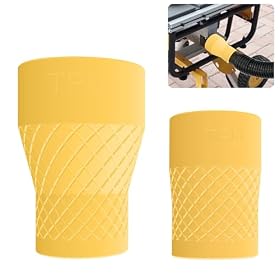
The best shop vac hose for a miter saw fits both ports securely, stays flexible without collapsing, and preserves enough airflow to capture sawdust. Here is how to choose the right size and set it up correctly.
A good shop vac hose for a miter saw should connect securely to the saw and vacuum, remain flexible as the saw head moves, and avoid restricting airflow. Before buying, measure or check both connection ports and confirm whether you need a reducer, adapter, or Y-fitting. A hose that is too small, too long, kinked, or loosely fitted can leave sawdust around the saw even when the vacuum works properly.
What to look for in a miter saw hose
Match the hose to both connection ports
Miter saw dust ports and shop vac inlets are not always the same size. Common shop vac hose sizes include 1-1/4 inch, 1-1/2 inch, and 2-1/2 inch, but the actual outside or inside diameter can vary by brand and connector style.
Check:
The diameter of the miter saw dust port
The diameter of the shop vac inlet or hose cuff
Whether each connection is designed for an inside or outside fit
Whether the hose includes compatible cuffs or requires adapters
Do not choose based only on the vacuum’s advertised hose size. Measure the connection points or consult the manuals for both machines. A slightly flexible rubber or tapered adapter can provide a better fit than forcing one hose directly onto an incompatible port.
Choose a flexible hose that does not collapse
A miter saw hose needs to bend as the saw pivots and slides. A stiff hose can pull on the dust port, interfere with the saw’s movement, or disconnect when the saw is lowered.
Look for a hose that:
Bends smoothly without sharply kinking
Keeps its opening when bent
Is long enough to allow the full range of saw movement
Is not so long that it creates unnecessary airflow resistance or loops across the work area
Keep the hose supported behind or beside the saw rather than allowing its full weight to hang from the dust port.
Balance hose diameter with dust collection
A larger hose can allow more airflow, but it may not connect directly to a small miter saw port. A smaller hose may fit the saw but restrict the vacuum, especially if it is long or clogged.
For many portable miter-saw setups, the most practical arrangement is a hose that fits the saw port through a properly sized adapter and connects to the shop vac without a sharp internal step or loose gap. The best diameter is the one that provides a secure, reasonably direct path while matching the limitations of both machines.
Consider the hose cuff and adapter design
The cuff is often as important as the hose itself. A threaded, tapered, or stepped cuff may fit some ports but not others. Universal adapters can work, but they may need trimming to match a particular port. Only remove material if the adapter manufacturer allows it and you can maintain a secure connection.
Avoid relying on a loose friction fit if the hose repeatedly falls off. A proper adapter, clamp designed for the connection, or compatible replacement cuff is usually a better long-term solution than wrapping the joint with excessive tape.
How to set up a shop vac with a miter saw
Unplug the saw before connecting accessories. Keep the saw and vacuum off while routing the hose.
Attach the hose to the vacuum and saw. Make sure each cuff is fully seated and does not obstruct the dust port.
Route the hose behind the saw. Leave enough slack for bevel, miter, and sliding movements.
Check the full range of motion by hand. The hose should not pull, kink, touch the blade area, or catch on the saw stand.
Turn on the vacuum before cutting. If the vacuum has an automatic tool-start outlet, verify that its ratings and instructions are appropriate for the saw.
Make a short test cut in scrap material. Check for leaks, disconnections, and dust escaping at the guard or collection point.
A miter saw may still produce some airborne dust because the blade is partially exposed and the factory dust chute is not perfectly sealed. A hose improves collection but does not replace eye protection, respiratory protection when appropriate, or good ventilation.
Product prices and availability are accurate as of the date/time indicated and are subject to change. Any price and availability information displayed on Amazon.com at the time of purchase will apply to the purchase of this product.
One hose or a Y-fitting?
Use one hose when the priority is maximum airflow through the saw’s dust port. A Y-fitting can also connect the vacuum to a second pickup point, such as a hood behind the saw, but splitting the airflow may reduce suction at both openings.
If you use a Y-fitting:
Keep the branches as short and smooth as practical
Use blast gates or shutoff valves so unused branches can be closed
Avoid sharp bends immediately before the saw port
Confirm that the vacuum can handle the added restriction
A secondary hood can help with dust that escapes around the blade, but the saw’s own dust chute should still have a clear, well-fitting hose.
Product prices and availability are accurate as of the date/time indicated and are subject to change. Any price and availability information displayed on Amazon.com at the time of purchase will apply to the purchase of this product.
If the hose keeps falling off
Check the connection in this order:
Confirm that the hose cuff matches the port diameter.
Remove sawdust from inside the port and cuff.
Check whether the cuff is cracked, stretched, or missing an internal retaining feature.
Make sure the hose is not pulling sideways because it is too short or poorly routed.
Replace an incompatible cuff or install the correct adapter.
Tape can temporarily reduce minor looseness, but it is not a substitute for a correctly sized connector—especially if the joint is exposed to repeated movement.
Product prices and availability are accurate as of the date/time indicated and are subject to change. Any price and availability information displayed on Amazon.com at the time of purchase will apply to the purchase of this product.
If dust collection is weak
Start with the simple physical causes:
Inspect the filter. A clogged shop vac filter can reduce airflow. Clean or replace it according to the vacuum manufacturer’s instructions and use the filter intended for the material being collected.
Check the hose for blockages. Disconnect it and look through the hose. Fine dust, wood chips, or a stuck offcut can create a major restriction.
Inspect the cuffs and joints. Air leaks at the saw port, adapter, or vacuum inlet reduce collection efficiency.
Check the setup. Look for kinks, tight bends, an overly long hose, or a reducer with a very small opening.
Empty the drum or replace the bag. A full container or bag can limit airflow even when the motor is running.
Check the saw’s dust chute. Remove accumulated chips from the chute and guard area only with the saw unplugged.
Consider the material and cut. Fine dust and repeated cuts can overwhelm a small portable vacuum, while some saw designs release dust outside the collection path.
If airflow remains weak after the hose, filter, container, and connections are clear, inspect the vacuum according to its manual. Stop using it if the motor smells hot, makes unusual noises, trips a breaker, or shows damaged wiring. Electrical or motor repairs should follow the manufacturer’s instructions or be handled by a qualified professional.
When to replace the hose
Replace the hose when it has splits, crushed sections that will not recover, loose cuffs, severe internal buildup, or repeated disconnections despite using the correct adapter. A replacement hose is also reasonable when the existing hose is too short to let the saw move freely or so restrictive that it noticeably reduces collection.
Replace the vacuum instead when the motor, drum, electrical components, or main suction system is failing and the unit is not economical or safe to repair. If the vacuum works normally with another hose and the problem follows the hose, replacing the hose or its cuff is the more targeted solution.
Quick buying checklist
Before ordering a shop vac hose for a miter saw, confirm:
The saw-port diameter and connection style
The shop vac inlet or cuff size
Whether the hose is flexible enough for the saw’s movement
Whether the hose resists collapse when bent
The included adapters and their usable opening sizes
The length needed without excessive loops
Whether replacement cuffs or reducers are available
Whether the hose is intended for wood dust and shop-vac use
A correctly fitted hose and adapter usually improve dust collection more than simply choosing the longest or largest hose available.
FAQ
What size shop vac hose fits a miter saw?
There is no single universal size. Miter saw ports and shop vac inlets commonly use different diameters, so check both machines’ manuals or measure the connection points. You may need a reducer or tapered adapter.
Is a 2-1/2-inch hose better for a miter saw?
A larger hose can support more airflow, but it may not fit the saw’s dust port directly. Use the largest practical hose that connects securely through a properly sized adapter without creating a severely restricted opening.
Can I use a shop vac hose that is longer than necessary?
You can, but extra length and bends add airflow resistance and create more opportunities for kinks. Choose enough length for the saw’s full movement, then route and support the hose so it does not pull on the dust port.
Why does my miter saw still make dust when connected to a shop vac?
Some dust escapes because miter saw guards and chutes do not capture every chip. Also check the filter, hose, cuffs, saw chute, drum or bag, and adapter for restrictions or leaks. A secondary dust hood may help with dust that misses the saw’s collection port.