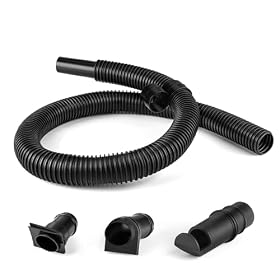
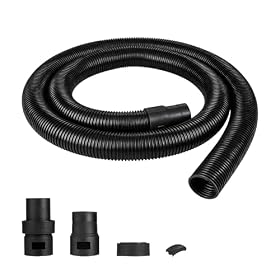
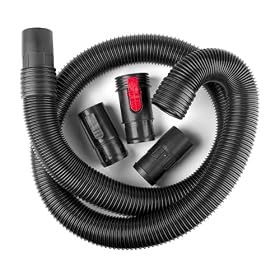
A 2-1/2-inch shop vac hose usually moves more air and resists clogs better, while a 1-1/4-inch hose is lighter and easier to handle for detail work. The right choice depends on your vacuum inlet, attachments, and the material you collect.
What do you need help with?
Open an answer, or tell us what we should cover next.
Answered in this guide
Choose the right shop vac hose size
Choose a 1-1/4-inch hose for lighter detail work and easier handling. Choose a 2-1/2-inch hose for general cleanup, larger debris, sawdust, construction dust, and better resistance to clogs.
Understand how hose diameter affects shop vac performance
A larger hose generally allows more airflow and moves larger debris with less restriction. A smaller hose is easier to handle but may limit airflow and clog more easily with bulky material.
Check the vacuum inlet, attachment ends, cuffs, connection shape, and proprietary fittings instead of relying only on the listed hose diameter when choosing a hose or accessory.
A properly sized adapter or reducer can connect a 1-1/4-inch accessory to a 2-1/2-inch hose, or the reverse. The adapter cannot remove the airflow limits of the smaller passage.
Compare length, flexibility, crush resistance, and cuff design along with diameter. Longer hoses add reach but can increase friction and make storage harder, while stronger construction helps prevent collapse.
Request a topic and help us choose what to build next.
Measure a shop vac port before buying a replacement hose
Install and seal a shop vac hose adapter
Fix weak suction or a clogged shop vac hose
Choose a replacement hose for a specific shop vac model
Requests help us prioritize the next guide. No email required.
One anonymous request per topic.
A 2-1/2-inch shop vac hose is generally the better choice for maximum airflow, larger debris, and longer runs, while a 1-1/4-inch hose is easier to handle for car interiors, furniture, and detail attachments. Before buying, match the hose to the vacuum inlet and the attachments you plan to use—nominal hose sizes are not universal connection standards.
Quick comparison
Feature
1-1/4-inch hose
2-1/2-inch hose
Best for
Detail cleaning, cars, furniture, small tools
General cleanup, sawdust, chips, water, larger debris
Airflow potential
Lower
Higher
Clog resistance
More likely to clog with larger debris
Better for chips and bulky material
Handling
Lighter and easier to maneuver
Heavier and less flexible
Tool compatibility
Common with detail and small-tool attachments
Common with full-size shop vac accessories and power tools
Space needed
Smaller
Larger
Main drawback
Can restrict airflow and clog sooner
May be awkward for fine-detail work
What the hose diameter changes
The diameter affects how much air and debris can move through the hose. A larger hose generally creates less restriction, which can help a shop vacuum maintain airflow when collecting sawdust, wood chips, leaves, and other bulky material.
A smaller hose concentrates the airflow through a narrower opening. That can work well with small nozzles and detail tools, but the hose has less room for larger debris. A wad of sawdust, a wood shaving, or a damp clump of material is more likely to cause a blockage in a 1-1/4-inch hose.
Hose diameter is only one part of vacuum performance. The motor, filter condition, hose length, bends, seals, and attachment design also affect the suction you feel at the nozzle. Replacing a small hose with a larger one does not automatically make a shop vac more powerful.
Product prices and availability are accurate as of the date/time indicated and are subject to change. Any price and availability information displayed on Amazon.com at the time of purchase will apply to the purchase of this product.
Choose a 1-1/4-inch hose when maneuverability matters
A 1-1/4-inch hose is usually the more convenient option for:
Cleaning vehicle interiors
Vacuuming stairs, shelves, and furniture
Reaching into narrow spaces
Using small crevice tools and detail brushes
Light-duty dust collection from small hand tools
Jobs where the hose must be carried and repositioned frequently
Its smaller size and lower weight can make detail cleaning less tiring. It is also easier to guide around seats, cabinets, and other obstacles.
The tradeoff is reduced capacity for bulky debris. If you regularly collect wood chips, chunks of drywall, wet leaves, or coarse workshop debris, check the hose for blockages more often and consider a larger diameter.
Product prices and availability are accurate as of the date/time indicated and are subject to change. Any price and availability information displayed on Amazon.com at the time of purchase will apply to the purchase of this product.
Choose a 2-1/2-inch hose for general cleanup and larger debris
Water pickup, when the vacuum is designed for wet use
Leaf and garage cleanup
Power-tool dust ports that use larger connections
Longer hose runs where airflow restriction matters
The larger opening is less likely to plug with chips or clumps of debris. It can also make general cleanup faster because the nozzle covers more area and the hose can move larger material more easily.
The disadvantages are size and handling. A 2-1/2-inch hose may feel bulky in a vehicle or around furniture, and it may not connect directly to small detail attachments.
Product prices and availability are accurate as of the date/time indicated and are subject to change. Any price and availability information displayed on Amazon.com at the time of purchase will apply to the purchase of this product.
Fit matters more than the label
Do not assume every 1-1/4-inch or 2-1/2-inch hose will fit every shop vac with the same labeled size. Manufacturers may use different connection shapes, cuffs, friction-fit ends, or proprietary fittings. The stated size may refer to the approximate inside diameter, outside diameter, or accessory connection size.
Before ordering, check:
The vacuum inlet: Measure it if the manufacturer does not clearly list the hose size.
The hose cuff: Confirm whether the cuff inserts into the inlet or fits over it.
The attachment ends: Some hoses have different ends, stepped adapters, or rotating cuffs.
The tool port: Power tools and dust separators may require a separate adapter.
The manufacturer’s compatibility list: This is the safest reference when available.
If the hose seems close but will not seat securely, do not rely on tape as a permanent fix. A loose connection leaks air and can let dust escape. A connection that is too tight can damage the inlet or accessory cuff.
Can you use an adapter between the two sizes?
Yes, a properly sized adapter or reducer can connect a 1-1/4-inch accessory to a 2-1/2-inch hose, or the reverse. However, an adapter does not eliminate the airflow limitations of the smaller passage.
For example, a 2-1/2-inch hose connected to a 1-1/4-inch tool port may still be useful because the larger hose carries material with less restriction, but the narrow tool port remains a restriction point. A reducer may also catch debris if it has an abrupt internal step.
Use an adapter when it solves a specific compatibility problem, such as connecting a detail nozzle or power-tool dust port. For frequent switching between sizes, an accessory kit with a secure, correctly sized adapter is usually more practical than improvised couplers.
Hose length, flexibility, and construction
Diameter is important, but these specifications also affect the buying decision:
Length
A longer hose gives you more reach but adds surface friction and usually makes storage more difficult. For the same vacuum, a long narrow hose can restrict airflow more noticeably than a short one. Choose enough length to reach your work area without creating unnecessary loops.
Flexibility
A flexible hose is easier to use around furniture and vehicles. Very soft hoses may kink or collapse at tight bends, while stiffer hoses can be harder to maneuver but may hold their shape better. Look for a hose intended for the vacuum’s normal use rather than choosing by diameter alone.
Crush resistance
If the hose will be driven over, stepped on, or dragged across a busy workshop floor, crush resistance matters. A hose that repeatedly collapses can reduce airflow even if its nominal diameter is large.
Cuff and end design
A hose with a rotating cuff can be easier to use because it helps reduce twisting. Different end designs may also determine whether the hose connects directly to the vacuum, a wand, a floor nozzle, or a power tool.
Which size is better for fine dust?
Neither hose size replaces the correct filter, bag, or dust-control setup. Fine dust can pass through an incorrectly configured wet-dry vacuum even when the hose has excellent airflow.
For fine dust, use the filter and collection bag recommended for that material and vacuum. Keep the filter clean, seal connections properly, and follow the tool and vacuum manufacturer’s instructions. A 2-1/2-inch hose may help move dust from a power tool with less restriction, but it does not by itself provide fine-dust filtration.
Which size is better for water pickup?
A 2-1/2-inch hose is generally more convenient for moving larger volumes of water and is less prone to blockage from debris mixed into the water. However, the vacuum must be configured for wet pickup according to its instructions. Remove or change filters and collection components only as the manufacturer directs.
Never use a vacuum for liquids if its manual does not allow wet pickup, and keep electrical connections away from standing water.
How to decide between the two sizes
Use this simple rule:
Choose 1-1/4 inches if your priority is light handling, vehicle cleaning, furniture, stairs, and small detail tools.
Choose 2-1/2 inches if your priority is workshop cleanup, larger debris, water pickup, power-tool connections, and reduced clogging.
Choose a larger hose with an adapter if you need general cleanup capacity but occasionally use small accessories.
Choose the manufacturer-specific replacement hose when fit is uncertain or the vacuum uses a proprietary connection.
If you already own both sizes, use the larger hose for bulk cleanup and the smaller hose only where its lighter handling or smaller nozzle is useful.
FAQ
Is a 2-1/2-inch shop vac hose stronger than a 1-1/4-inch hose?
Not necessarily. A 2-1/2-inch hose usually has greater airflow capacity and clog resistance, but strength depends on the hose’s construction, crush resistance, wall thickness, and materials.
Can I put a 1-1/4-inch hose on a 2-1/2-inch shop vac?
Often, but not always. You may need a compatible reducer or adapter, and the hose must seal securely at the vacuum inlet. Check the vacuum and hose manufacturer’s compatibility information before buying.
Does a larger shop vac hose increase suction?
A larger hose can reduce airflow restriction and help the vacuum move more air, but it does not increase the motor’s rated power. Actual pickup depends on the vacuum, filter, hose length, seals, and nozzle.
What shop vac hose size is best for sawdust?
A 2-1/2-inch hose is generally the more practical choice for sawdust and wood chips because it is less likely to clog and commonly matches larger workshop attachments. Use the correct filter and dust-collection setup as well.
Why does my replacement shop vac hose not fit even though the size matches?
The labeled size may describe a nominal diameter rather than the exact connection dimensions. The hose may also use a different cuff style or proprietary fitting. Compare the inlet, cuff, and attachment-end measurements and use the manufacturer’s recommended replacement when possible.