
A good shop vac location is close enough to the tools you use most, but not in a walkway or where its exhaust will blow dust back across your work. Keep the vac accessible for emptying and filter changes, and leave its air inlets and exhaust unobstructed.
Setup & Use · Tue Sep 15
Where to Place a Shop Vac in a Workshop
Place your shop vac close enough to reach your tools, but out of walkways and away from the dust cloud and the vac’s exhaust. Leave room for airflow, emptying, and filter changes.
Choose a spot near your main work area {#choose-a-spot-near-your-main-work-area}
For a portable vac, park it just outside the immediate work zone—near a bench or tool, but clear of the path you walk and the space where you handle long boards or materials. That reduces trips over the hose and cord while keeping the vac easy to move.
If you use the vac with one stationary tool most of the time, position it near that tool and check that the hose reaches without stretching, sharp bends, or pulling the vac over. A longer hose can improve reach, but extra length and bends may reduce airflow. Use a hose compatible with your vacuum and follow the manufacturer’s guidance.
Extend reach without moving the vacuum
 ALL PARTS ETC. 1.25 Inch Vacuum Extension Wands, 32mm Vacuum Accessories & Attachments | 15.75"…ALL PARTS ETC.
$15.99 as of
View on Amazon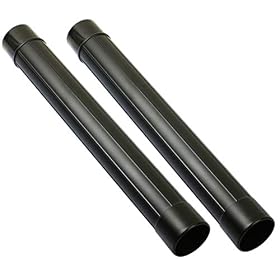 ALL PARTS ETC. 2.5 Inch Vacuum Extension Wands 19" Long for Shop Vac, Rigid, Vacmaster,…ALL PARTS ETC.
$25.99 as of
View on Amazon Cen-Tec Systems 94709 Quick Click 16 Ft. Hose for Home and Shop Vacuums with Expanded…Cen-Tec Systems
$58.75 as of
View on Amazon
Product prices and availability are accurate as of the date/time indicated and are subject to change. Any price and availability information displayed on Amazon.com at the time of purchase will apply to the purchase of this product.
Keep dust, exhaust, and noise in mind {#keep-dust-exhaust-and-noise-in-mind}
Place the intake near the tool’s dust port, but keep the vacuum’s exhaust from blowing across the work surface or toward other people. Don’t tuck the vac into a closed cabinet or tight enclosure: it needs clear airflow and room to cool.
If a tool produces fine dust, use a vacuum and filter suitable for that dust and tool, following their instructions. A shop vac’s location alone does not make it suitable for every dust hazard. Use the required dust-control measures and protective equipment for the material and task.
If noise is an issue, move the vac farther from the main work position when the hose still reaches effectively. Avoid placing it where its exhaust or vibration will disturb loose materials or nearby work.
Keep the hose and cord out of traffic {#keep-the-hose-and-cord-out-of-traffic}
Route the hose and power cord along the edge of the work area rather than across a doorway or the usual walking path. Before starting, check that neither can snag on a tool, catch under a wheel, or pull the vacuum toward a bench edge. If you need overhead hose support, use a suitable support installed securely; don’t suspend the vacuum itself from an improvised mount.
Choose a dry, stable spot where the vac cannot be struck by moving stock or machinery. Follow the vacuum’s instructions for electrical connections, including any restrictions on extension cords. Don’t overload a circuit or use damaged cords.
Do a quick placement check {#do-a-quick-placement-check}
Before working, connect the hose and move through the task as you normally would. Confirm that the hose reaches without kinking, the cord stays clear, and the vac remains stable. Check that you can reach the switch and open the drum or canister for emptying and maintenance.
If the hose repeatedly blocks a walkway or gets pulled tight, move the vac or adjust the hose route. If no safe location gives you enough reach, a compatible extension hose may help, but check the vacuum maker’s guidance because added hose length can reduce performance.
FAQ
Should a shop vac be near or far from the tool?
Keep it close enough for the hose to reach without stretching or kinking, but place it outside walkways and where its exhaust will not blow dust across the work area.
Can I put a shop vac in a cabinet?
Avoid a closed or cramped cabinet unless the vacuum’s instructions specifically allow that setup. The motor needs airflow, and you need room to access the drum, filter, and controls.
Does a longer shop vac hose reduce suction?
It can reduce airflow, especially when the hose is long, narrow, or sharply bent. Use a compatible hose and follow the vacuum manufacturer’s recommendations.